

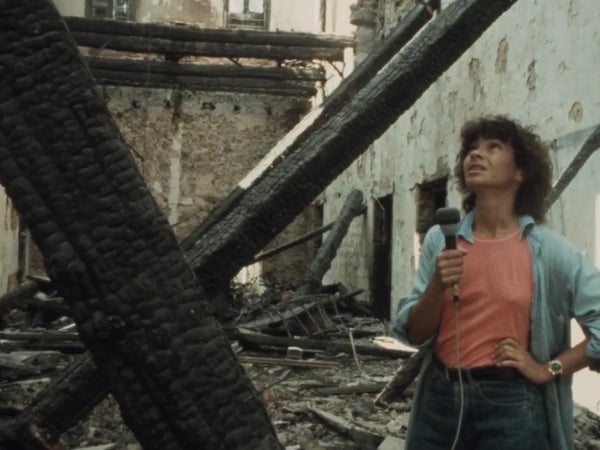
As Lebanon faces attacks from Israel, Jocelyne Saab's films take on a renewed sense of urgency and sadness.
“The June 1967 defeat was tantamount to an alarm bell that aroused the dormant Arab consciousness from its long slumber; it awakened the Arabs from their dreaming, shaking their faith in all the nationalistic slogans and bringing into question the ability of the military regimes to fulfill the duties they had taken unto themselves and had so loftily and widely declared.”
This was Tunisian filmmaker Nouri Bouzid's introduction to his analysis of post-1967 Arab cinema in ‘New Realism in Arab Cinema: the Defeat-Conscious Cinema’. The loss of the Arab armies against Israel that year, and the ensuing disillusionment with Pan-Arab unity, resulted in the filmmakers of this time and place finding new ways to capture a culturally decaying world. This is most notably seen in the “New Lebanese Cinema” of the 1970s and 1980s, where filmmakers like Heiny Srour and Jocelyne Saab blended documentary and fiction, as well as the personal and the political, to create films where human life endured amidst rubble.
If the loss of the Six-Day War awakened Arabs from a dream, the following decades only brought nightmares. The Lebanese Civil War broke out in 1975 – a 15-year-long conflict that led to an estimated 150,000 people killed. Saab, a reporter based in Paris at the time, returned to Beirut, and would go on to make a number of documentary films capturing the destruction of the city she was born in. In only a few years, her non-fiction work evolved to take a more personal and poetic style of capture. The Beirut Trilogy – comprising Beirut, Never Again (1976), A Letter from Beirut (1978), and Beirut, My City (1983) – depicts the schism within Lebanon and the subsequent involvement from Israeli, Arab, and United Nations forces like a curse that has befallen Lebanon. Civilians attempt the mundanities of everyday life whilst refugees in their own houses.
Beirut, Never Again opens with discordant screeching and the sound of gunshots, soundtracking a montage of destroyed buildings and choked streets. Saab narrates, calling a Beirut that once was with both reverence and sadness. She describes the tourists who once frequented the city as flies, and the luxury items that were “carelessly” imported. She also details the city’s once beautiful architecture. It is a bitter, broken poetry on display. All of the good and bad of before is yearned for, while everything in frame is a ghost of its former self.
While the narration of the film laments a past never to return, Saab’s camera remains focused on the present circumstances of Beirut’s people. Life and death are always in the same frame. Children inhabit the streets as if they are newly created yet desecrated playgrounds, playing in polluted waters while corpses lay on the beach. People frequently walk past the camera sporting AK-47s along with flowers. In one moment, a trio of grenades are seen cradling a deck of cards placed upon a chair, both items ready to be used by a nearby group of young men and boys in case either leisure or lethality find them. It is almost always true that the people holding the weapons aren’t much bigger than the guns themselves. “The older the war gets, the younger the fighters are becoming," Saab remarks despondently.
Two years later, Saab would complete A Letter from Beirut, which continues this focus on the attempted ordinary routines of people experiencing catastrophe. Long stretches of the film show the candid conversations between civilians taking the public buses, as Saab herself travels across the partitions to capture the various sides of the war. Often people speak of the places they cannot go and those they cannot see. One woman speaks of how she used to attend college, but now the bus cannot cross the military demarcation lines; another lost her home to the war, leaving her and her 12 children stranded; yet another explains her husband and son have been kidnapped. The bombings from various armies, including Israel and their scorched earth policy, renders the countryside uninhabitable. At one point a young boy points at various houses while naming who lives there, but when the film cuts to the home, it has been demolished.
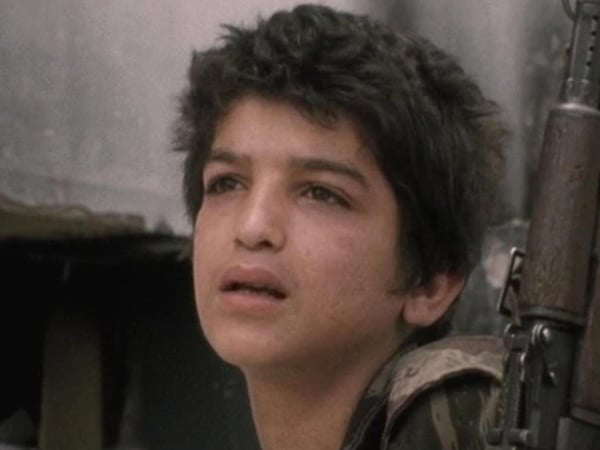
To watch Saab’s films – which reckoned with the tragic past, present, and future of Lebanon – in 2026 is to mournfully witness history chase its own tail. Beirut, My City spends ample time unpacking the violence of the years prior, only to end with the narrator presaging the Sabra and Shatila massacre, where thousands of Palestinians and Lebanese Shias were killed by the IDF and Lebanese forces. The documentary footage we see was shot before the atrocity occurred, while the film was completed in its aftermath.
In this way, every image of the film is haunted by the future horrors to come, both the ones it knows for certain and the ones that it does not, the ones that we the living are currently bearing witness to. In our present day, America and Israel have spent the last few weeks at war with Iran, escalating an imperialist bloodthirst they’ve cultivated over the last few decades. Alongside attacks on Iran, Israel has expanded and intensified operations throughout Lebanon, killing over 1,500 people and displacing another one million from their homes. These tactics of domicide currently being used in Lebanon were also used in the eradication of Gaza just a few years earlier.
The experience of such pattern recognition is shattering. How many buildings have been destroyed? How much rubble has filled the streets? How many corpses have been pulled out of the ruins that result from such heinous acts of cruelty? We watch Saab’s films and bear witness to agony, only to find it echoed on the screens we carry with us everywhere. Every image has been recreated – in Gaza, in Iran, in Lebanon, again and again.
Even if any tenuous ceasefire agreements are ever upheld, which they currently aren’t, the suffering caused by Israel and the United States in Lebanon and beyond over these last few months will be remembered long after, compounding upon what millions have endured in the years prior. The pessimism that can come from these circumstances is natural, but Saab’s films maintained a lively political commitment, always showing with clarity who the oppressor was, and that intimate bonds could be formed between people in spite of the alienation caused by destruction. One moment from A Letter from Beirut shows two men, a bus driver and passenger, warmly embracing. Their deep friendship is immediately apparent, and they wistfully hope for a future where they can spend time together as often as they once did before the war.
The Beirut Trilogy managed to show that life can sprout up and persist amidst such unconscionable conditions. In their own way, like the people themselves, these documentaries had faith that there would be a future, even if it was through gritted teeth and painful memories. As the narrator in Beirut, My City says: “When people asked, ‘How are you?’ We'd sneer and say, ‘Still alive!’” But the question that lingered in Saab’s trilogy still torments our world now: will what comes after ever be anything other than an intensification of yesterday?
from Little White Lies - Main https://ift.tt/MtgcEul
0 Comments