

A revitalising shot of pure entertainment from writer/director Martin McDonagh that also operates as a salty critique of modern US foreign policy.
Even when it looks like Irish writer/ director Martin McDonagh has one foot deeply set in his comfort zone – the tawdry world of dysfunctional male friendships – the other foot is somewhere else entirely, this time tramping the fertile ground of JFK conspiracy theories and America’s checkered history of destabilising nascent democracies around the globe. With his barnstorming Wild Horse Nine we’re in Chile circa 1973, and the populace is riding a wave of fevered awe following the election of socialist president, Salvador Allende.
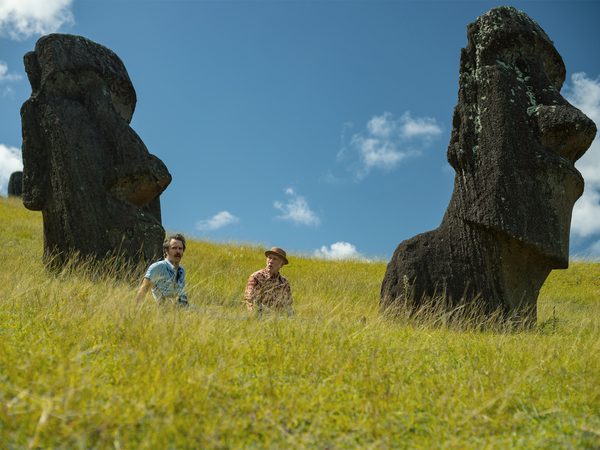
Chris (John Malkovich) and Lee (Sam Rockwell) are a pair of jaded CIA lowlifes stationed in Chile, heading on a stint of leave to Rapa Nui (Easter Island) in the knowledge that Allende’s days are numbered and their (boot)boy Augusto Pinochet is waiting in the wings. At first, the pair appear to be on a break for a job well done – loping around, munching junk food, taking in the giant heads while Lee captures the landscape on his 8mm camera. It transpires that he is in fact on a secret mission, one that demands that he takes stock of his friendship with the volatile Chris, who the powers that be (including Steve Buscemi’s bureau chief MJ) believe might be about to air some very dirty laundry about his own activities inside the agency.
The film offers a sublime fusion of salty rhetoric and colourful existential malaise, as Chris comes to terms with the fact that he doesn’t have long left on this world by working on his own eccentric definition of goodness. Eventually he finds himself trapped in the Good German paradox – what if he is essentially a forthright dude who did his bit for global justice, but that happened to involve double-tapping scores of potentially righteous men and women who just happened to cherish ideals that opposed those held by Uncle Sam. And forget people – consider the moth, whose lowly lot and suicidal tendenceies should absolutely afford them a place among God’s holy annointed. Malkovich plays Chris as a kind of rambling poet savant, disarmingly flippant about global atrocities but suddenly circumspect when he realises that his actions likely caused the deaths of tens if not hundreds of thousands of political dissidents by proxy.
There’s the suggestion that Chris’s volte-face is catalysed by the appearance of Monica (Mariana di Girolamo), a student supporter of Allende who is on holiday in Rapa Nui. She represents the wide-eyed hope of radical political transformation and is excited to see how Chile’s first socialist government plays out. Chris is tickled by her optimism, and rather than assure that things are going to be all right, he almost attempts to take her under his wing and harden her for the battle ahead. Their conversations illustrate the serious undertow injected by McDonagh to all the macho larks – that these global far-right outposts whose destiny has been massaged by backroom operators will heel to their American masters while also administering brutal punishment to their own citizens. Maybe saving one person will secure that ticket through the pearly gates for Chris?
Although Wild Horse Nine has much in common with the perma-bickering lads of In Bruges and The Banshees of Inisherin, McDonagh’s depiction of the CIA as louche, boorish reprobates in search for some kind of soul allies it more to the great novels of mid-century American malaise, such as James Ellroy’s ‘American Tabloid’ or Don DeLillo’s ‘Libra’. Yet the large majority of the film’s enjoyment stems from the tiki-taka repartee between Malkovich and Rockwell, who fling sassy rejoinders back and forth and play their roles as if they’re brothers, split by generations but with a bond that appears to transcend banal friendship. The film also offers a juicy inquiry into national histories lost to elaborate cover-ups, and that the magnitude of information that some are set to take to the grave with them can sometimes be too much to bear.
The film, about a man who eventually has to be scrubbed out, having caused too much mischief in this world, in some ways recalls John Steinbeck’s ‘Of Mice and Men’, in an adaptation of which Malkovich once starred (Gary Sinise’s 1992 English lit class perennial) as the tragic Lennie, who succumbs to a similar fate. Like Steinbeck’s, McDonagh’s stories all focus on intimate, often violent personal altercations, but they all come with a build-your-own political context that offers a panoramic snapshot of a moment in time. Three Billboards Outside Ebbing, Missouri tossed a powderkeg into the world of post-George Floyd American policing. Banshees served as an expansive metaphor for the impossibility of political diplomacy. Finally, Wild Horse Nine employs apocryphal histories to admonish the generations representing the type of backroom American imperialism that even the current Commander in Chief still enjoys.
It’s not just Chris who’s trapped in a deep moral quandary, finding some respite in wandering among the Big Heads and recording a draft of his memoirs onto tape. Lee too has to decide where his duty lies – to his old partner or to his CIA paymasters. In one strange, touching scene, Chris and Lee are in a hotel restaurant, engaging in a snarky conversation with two British tourists who, attempting to be friendly, advise them of some of the correct references to local customs. Chris seems bemused at their little lecture, while Lee explodes and starts yelling at them – his protective acknowledgment that this is Chris’s trip and that no one should be talking down to them, even if they are unrefined goons.
The film keeps its cards fairly close to its chest in its knockabout first half, only laying down its flush of surprising melancholy and playful historical insight closer to the home stretch. There are some stellar supporting turns from di Girolamo, Parker Posey as Lee’s snap-talking ball and chain, as well as Tom Waits in a moving, climactic cameo. While Rockwell seems to do his best work with McDonagh, and this is no exception, flowers go to Malkovich, who delivers arguably his finest screen performance of the 21st century, demonstrating that it takes a master to make a morally despicable character such as Chris not just worth rooting for, but (almost) falling in love with.
from Little White Lies - Main https://ift.tt/DRT28YM


0 Comments